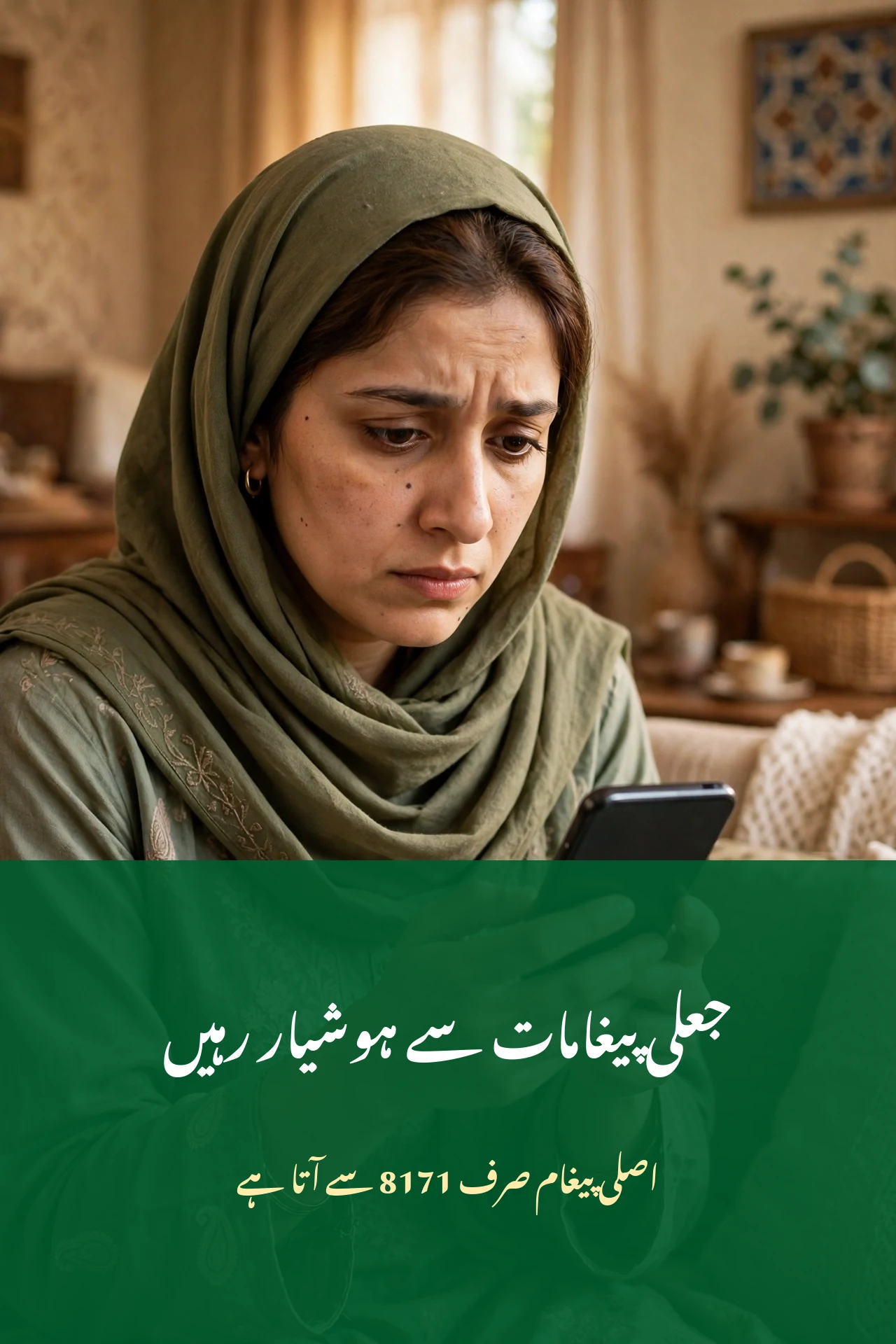
If a message says your BISP payment is ready but asks you to call a number, pay a fee, or share a code, stop. It is almost certainly fake. BISP sends SMS only from 8171 and never charges for registration, survey, or payment. This guide shows how to spot a fake BISP 8171 SMS or WhatsApp message, check your real status, and report the fraud.
Quick Overview
| Programme | BISP Kafaalat |
| Official SMS number | 8171 only |
| Official portal | 8171.bisp.gov.pk |
| BISP helpline | 0800-26477 (toll-free) |
| Current Kafaalat payment | Rs. 14,500 per quarter, Oct-Dec 2026 |
| Next announced payment | Rs. 18,000 from January 2027 |
| Registration and survey fee | Rs. 0 – always free |
| BISP never asks for | Fee, PIN, OTP, CNIC photo on WhatsApp, bank details |
| If you get a fake message | Do not reply, click, or pay – report it |
Latest Update: BISP’s Repeated Warning
BISP’s warning is plain: no survey fee, 8171 is the only official number, and any other number means fraud.
BISP Chairperson Senator Rubina Khalid repeated it at a Faisalabad registry centre: no survey fee, messages only through 8171, complaints to 0800-26477.
If a message breaks it, it is not from BISP, however official it looks.
Who Is Targeted – and Why These Messages Work
Scammers target those who need money most: Kafaalat women, widows, elderly women, families awaiting payment. They use fear (your name will be removed) and excitement (your payment is approved) to make you act before thinking. If a message worried you, do not feel ashamed; stop, check officially, and report it.
Red Flags: 10 Signs a Message Is Fake
Even one red flag is enough reason to stop.
- Sender is not 8171. An ordinary mobile number, WhatsApp account, or lookalike code.
- Asks you to call a number. Real BISP messages never do this to release a payment.
- Asks for a fee. Registration, survey, status checks, and collection are all free; any processing fee is fraud.
- Asks for your OTP or PIN. BISP never asks for these.
- Asks for a CNIC photo. Never send a CNIC photo or number to a WhatsApp agent.
- Contains a link. Do not click it; type the official address yourself.
- Threatens you. Your name will be removed is a threat, not a BISP notice.
- Promises a different amount. Any amount unlike the real payment means fake.
- Comes via WhatsApp or Facebook. BISP does not run registration or approval through them.
- Rushes you. Reply in 10 minutes – urgency is a scammer’s favourite tool.

Real Amount vs Fake Promises
| What the message says | What is true |
| Your payment this quarter is Rs. 14,500 | True – the real installment for Oct-Dec 2026 |
| From January 2027 you will get Rs. 18,000 | True – announced increase for January 2027 |
| You have won a bonus on top of your installment | Fake – BISP has announced no such bonus |
| Your payment is Rs. 25,000, Rs. 50,000, or another large amount | Fake – does not match the real payment |
| Your payment is Rs. 12,000, and you must pay a fee to get the rest | Fake – no fee is ever needed for your full installment |
| Pay a small fee now and your payment will double | Fake – no such scheme exists |
Rule: an amount unlike Rs. 14,500 this quarter means fake – and even a right-looking amount from any number but 8171 is fake.
Important Dates
| Event | Date / Status |
| Current Kafaalat quarter | Oct-Dec 2026 – Rs. 14,500 per eligible woman |
| Announced payment increase | January 2027 – Rs. 18,000 |
| BISP fraud warning | Repeated in BISP press releases |
| New, separate 2026 fraud-alert date | Not officially announced |
| Benazir wallet / SIM deadline | 31 December 2026 |
Never accept a last date from a forwarded message alone – check the portal or helpline.

How to Check a Message in 60 Seconds
Every time you get a doubtful message:
- Sender: exactly 8171? A mobile number, WhatsApp name, or other code means fake.
- Demand: money, a code, a PIN, a CNIC photo, or bank details – any one means fake.
- Do not reply or click. Do not call the number, open its link, or forward it as real.
- Screenshot it. Save message and sender’s number as evidence.
- Check yourself. SMS your CNIC to 8171, or type 8171.bisp.gov.pk yourself – never use the message’s link.
- Compare. If your real status differs from the claim, the message was fake.
How to Verify Your Real BISP Status
Two official routes only:
- SMS: Send your 13-digit CNIC to 8171 for an official reply on eligibility and payment status.
- Portal: Type 8171.bisp.gov.pk yourself and enter your CNIC there.
Check the address letter by letter: exactly 8171.bisp.gov.pk, nothing added. A site like 8171-bisp-check.com is a different site, even with BISP’s logo. A browser padlock only means encryption, not that the site is BISP’s. If unsure, visit a Tehsil Office in person.
How to Report a Fake Message
Reporting helps BISP track these gangs:
- Save evidence. Keep the screenshot, sender’s number, and date/time; do not delete the message.
- Call 0800-26477 (toll-free). Say what the message said, who sent it, and whether you shared or paid anything.
- Visit a Tehsil Office if you can, with your original CNIC and the message on your phone.
- If money was stolen or an account hacked, ask helpline staff for the correct cybercrime channel – not a number from a forwarded message.
- Tell your family. Warn women in your household and neighbourhood.
A Note on the 9911 Number You May See Online
You may see web pages claiming 9911 is the cybercrime helpline. We are not using it as verified here: older FIA pages mention 1991, a 2019 report mentions 9911, and newer NCCIA pages mention 1799. As these disagree, none is presented as confirmed – start with 0800-26477 and let official staff direct you.

Common Scam Patterns, Explained
1. Your payment is approved, call this number
The most common trick: your Rs. 14,500 is approved and you must call to verify it. Whoever answers will ask for a fee, code, or CNIC details. Real approvals come only from 8171.
2. Fee for registration or survey
Someone says your survey is incomplete or a new round needs a fee. Registration and surveys are always free; real surveys happen at a BISP office or Dynamic Registry Centre, never via a paid WhatsApp agent.
3. Fake websites copying BISP branding
Fake sites copy BISP’s name, logo, and colours, then ask for CNIC, mobile, or wallet details. Only 8171.bisp.gov.pk and bisp.gov.pk are official.
4. WhatsApp agents promising faster approval
A WhatsApp contact claims to be a BISP officer and promises faster approval for a fee or details. BISP has no such agents or paid fast track.
5. Threats of expulsion or blocked payment
A caller says your payment is blocked unless you pay at once. This is a pressure trick – check your status through 8171 or at a Tehsil Office, and never pay someone who threatens you.
6. Fake forms on Facebook
Sponsored posts claim a special payment and ask for a form with CNIC and family details. BISP collects no registrations through Facebook forms.

What to Do If You Already Shared Information or Paid
Do not panic. Act quickly:
- Stop all contact. Do not reply, send more money, or share anything else, even if one more payment is promised to fix everything.
- Secure your money. If you shared an OTP, PIN, or bank/wallet details, contact that provider at once.
- Change your codes. Change any PIN or password shared; never reuse a code given to a stranger.
- Save everything as evidence: messages, numbers, receipts, screenshots.
- Report it. Call 0800-26477, visit a Tehsil Office, and say exactly what happened, including money paid.
- Check your real status via 8171 or the official portal; ignore what the scammer told you.
- Watch for recovery scams. Anyone offering to recover money for a fee is usually the same scammer.
Required Documents: What You NEVER Share vs What a Real Office Asks
| Never share by SMS, call, or WhatsApp | A real BISP office may ask you to bring |
| Your OTP or wallet/bank PIN | Your original CNIC |
| A photo of your CNIC | Children’s B-Forms, if asked |
| Your bank account details | Registered mobile number (SIM in your own name) |
| Any fee via JazzCash, Easypaisa, or bank transfer | Death certificate, for widows, where relevant |
| Your portal password | Disability certificate, where relevant |
A real office asks you to bring documents in person – never for money or codes over the phone.

Process Stages: From a Fake Message to a Safe Report
- Doubtful message arrives – do not reply, click, or pay.
- Check sender and demand – any red flag means fake.
- Save evidence – screenshot message and number.
- Verify real status – SMS CNIC to 8171 or use 8171.bisp.gov.pk.
- Report – call 0800-26477 or visit a Tehsil Office.
- Secure accounts if you shared codes or paid.
- Warn your family.
Common Problems and Fixes
| Problem | Real cause | Exact fix |
| Message from a mobile number | Ordinary-number scammer | Do not reply; check via 8171; report to 0800-26477 |
| WhatsApp agent asks for a fee | Paid agents do not exist | Do not pay; block it; report at a Tehsil Office |
| Website asks for CNIC and wallet details | Fake site | Close it; enter nothing; use only 8171.bisp.gov.pk |
| You shared your OTP with a caller | Scammer | Contact your bank/wallet provider at once; change PIN; report |
| You paid a fee and got nothing | Fraud | Save receipts/messages; report to 0800-26477 and a Tehsil Office |
| You clicked a link in a doubtful message | Possible fake site | Enter nothing; close it; if you entered details, report it |
Fraud Warning: Read This Before You Reply to Any BISP Message
This is the most important section of this guide, so read it slowly.
BISP sends SMS only from 8171. That is the whole rule. A message from any other number, WhatsApp account, or code is not from BISP, even if it uses BISP’s name, logo, or the words Benazir and Ehsaas.
Everything BISP does for you is free: registration, survey, status checks, and payment collection. Anyone asking for money at any step is not working for BISP.
BISP never asks for PIN, OTP, bank details, or a CNIC photo on WhatsApp or by phone, nor runs registration through WhatsApp, Facebook forms, or forwarded links. Payment is collected in person, after fingerprint verification, at a real payment point.
If a message makes you feel rushed, excited, or afraid, that feeling is the trick working. Pause, check through 8171, call 0800-26477, or go to a Tehsil Office – any one breaks the scam.
Tips for Beneficiaries
- Save the real numbers today: 8171 and 0800-26477, before you need them in a hurry.
- Type the portal address yourself. Bookmark 8171.bisp.gov.pk once checked; never click links in messages.
- Teach the rule: only 8171, never a fee, never a code.
- Count your full Rs. 14,500 at the counter; any deduction is illegal – report it on 0800-26477.
- Never let an agent use the portal for you. They can copy your details.
- When in doubt, go in person to a Tehsil Office.

Frequently Asked Questions
1. How do I know if a BISP SMS is real?
A real BISP message comes only from the short code 8171. It never asks you to pay a fee, share your OTP or PIN, or click a link to claim money. If the sender is an ordinary mobile number or a WhatsApp account, treat it as fake and do not reply.

2. Does BISP ever send messages through WhatsApp?
No. BISP does not run registration, approval, or payment messages through WhatsApp. Any WhatsApp message claiming to be from BISP, even with BISP’s name or logo, is not official. Check your status only through SMS to 8171 or the official portal.
3. What should I do when I receive a fake BISP message?
Do not reply, click any link, or call the number in the message. Take a screenshot of the message and the sender’s number, then check your real status through 8171. Report the message to the BISP helpline at 0800-26477 so it can be recorded.
4. Is there any fee for BISP registration or survey?
No, there is no fee at all. BISP registration and surveys are completely free, and checking your status or collecting your payment is also free. Anyone asking for a registration, processing, or agent fee is a scammer, and you should report them.
5. What is the real BISP payment amount in 2026?
The real Kafaalat installment is Rs. 14,500 per quarter for Oct-Dec 2026, rising to Rs. 18,000 from January 2027. Any message promising a different amount, a bonus, or a doubled payment does not match BISP’s announced payments and should be treated as fake.
6. How do I check my real BISP payment status?
Send your 13-digit CNIC number by SMS to 8171, or type 8171.bisp.gov.pk in your browser yourself and enter your CNIC there. Never use a link from a doubtful message. If you are unsure, visit your nearest BISP Tehsil Office in person for confirmation.
7. I already shared my OTP with a caller. What should I do now?
Stop all contact at once and do not send more money or details. Contact your bank or mobile wallet provider immediately and ask them to secure your account, then change any PIN you shared. Report what happened to the BISP helpline at 0800-26477 and keep all messages as evidence.
8. Can a fake website steal my BISP payment?
A fake website cannot take money directly from BISP, but it can steal the details scammers need to misuse your identity or wallet. If you entered your CNIC, OTP, or wallet details on a doubtful site, secure your accounts at once, change your codes, and report the site to 0800-26477.
9. Where do I report a fake BISP agent or a payment deduction?
Call the toll-free BISP helpline at 0800-26477 and give the agent’s number, the message, and any receipts you have. You can also complain in person at your nearest BISP Tehsil Office. Count your full Rs. 14,500 at the counter, because any deduction from your installment is illegal.

Conclusion
Fake BISP 8171 SMS and WhatsApp messages will keep coming, because they work on people waiting for help. But one rule defeats almost all: only 8171 is real, everything is free, and no one from BISP will ever ask for money or a code. Check your status yourself, report fakes to 0800-26477, and tell your family the rule.
Related guides
- BISP complaint registration guide
- What 8171 SMS replies mean
- Under-verification status explained
- Fingerprint verification failed fix
- December 2026 Kafaalat payment
- Benazir SIM and digital wallet
Sources
- Benazir Income Support Programme (BISP) – official website: https://bisp.gov.pk
- BISP 8171 Web Portal – official portal: https://8171.bisp.gov.pk
- BISP press release, Faisalabad visit: There Is No Fee for Survey in Benazir Income Support Programme, 8171 Is The Only Official BISP Number, Message From Any Other Number Is Fraud – https://bisp.gov.pk/SiteImage/Misc/files/12 Oct 24.pdf
- FIA National Response Centre for Cyber Crime (NR3C) FAQ – complaint routes and helpline history: https://www.nr3c.gov.pk/faq.html
Disclaimer
This information is based on official BISP announcements and may change. Always verify the latest details at bisp.gov.pk or through the official portal 8171.bisp.gov.pk, or by calling the BISP helpline at 0800-26477, before acting on any message about your payment.

