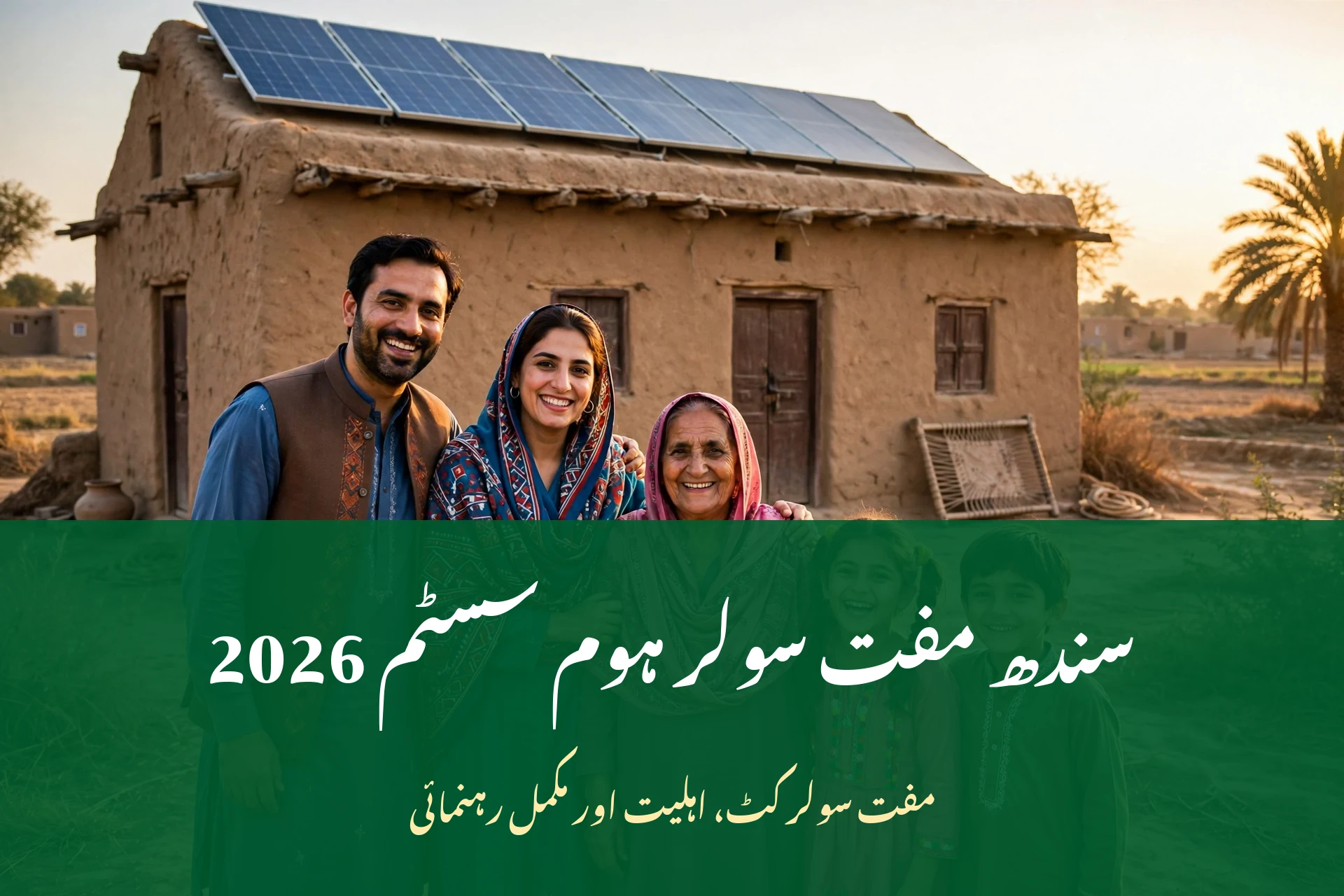
Sindh free solar home system 2026 is the Sindh government’s programme giving free solar kits to low-income families across the province. If your home has no electricity, or your bill is very small and the power keeps going off, the Sindh free solar home system 2026 scheme can give you light, a fan and mobile charging. This guide explains who can get it, what is inside the kit, and how to check your status.
Quick Overview
| Item | Detail |
|---|---|
| Programme | Sindh free solar home system 2026 (Solar Home Systems Project) |
| Run by | Energy Department Sindh; installation by SRSO |
| Free kits (new project) | 275,000 households — 132,000 off-grid and 143,000 on-grid |
| Earlier SSEP target | 200,000 solar home systems for BISP families |
| Project cost (new project) | Rs. 18.206 billion (Annual Development Programme) |
| Who gets it | Low-income Sindh families, mainly active BISP beneficiaries |
| What you get | Solar panel, battery, fan, LED lights and mobile charging |
| Cost to family | Free under the new project |
| Check BISP status | SMS your CNIC to 8171 or visit 8171.bisp.gov.pk |
| BISP helpline | 0800-26477 |
| Last date / online portal | Not officially announced |
What Changed in 2026
The Sindh free solar home system 2026 programme now runs in two linked tracks, and many guides on the internet mix them up. The new phase began with launch ceremonies on 15 April 2026 in Khairpur, Shikarpur, Larkana and Kamber-Shahdadkot. In the Sindh Budget 2026-27, the government approved Rs. 18.206 billion for free solar home systems for 275,000 low-income families.
On 17 July 2026, Chief Minister Syed Murad Ali Shah told the Energy Department at a CM House review meeting to speed up distribution. The project commenced in April 2025 and is scheduled for completion by June 2027. Senate committee documents reported 170,383 systems already installed, out of 191,794 approved forms, under the earlier 200,000-system target — the latest reported progress, not a live count.
The Two Tracks — Read This First So You Are Not Confused
Two tracks exist under the Sindh free solar home system 2026, with different kits, prices and target groups.
Track 1 — Sindh Solar Energy Project (SSEP), 200,000 systems. This World Bank-supported project is worth Rs. 27.4 billion, including 100 million dollars of World Bank support, and provides 200,000 systems to low-income households selected through BISP data in all 30 districts. The kit has an 80–100 watt solar panel, a minimum 18Ah lithium-ion battery, one DC fan, three LED bulbs and a mobile charging facility. The government pays about 80 per cent, and the beneficiary pays around Rs. 6,000 through a Sindh Bank challan.
Track 2 — Solar Home Systems Project (ADP), 275,000 systems, free. This newer track is fully free, funded through the Annual Development Programme at Rs. 18.206 billion. It gives 275,000 complete systems free: 132,000 kits for off-grid areas with no electricity, and 143,000 for on-grid protected consumers using 0–100 units a month. The poorest BISP families, with a poverty score from 0 to 20, get priority. NETC supplies the kits, and SRSO handles installation and after-sales service, including a two-year maintenance warranty.
If someone asks you for Rs. 6,000, that figure belongs to the older subsidised track — ask which track your form is under, and never pay an agent in cash.
Who Is Eligible
The Sindh free solar home system 2026 programme is not open to everyone in Sindh. It is meant for families who struggle most with electricity. These are the conditions reported from official briefings and project documents:
- You must be a permanent resident of Sindh, with a valid CNIC.
- Your family should be an active BISP beneficiary, selected through BISP data.
- Priority goes to families scoring 0 to 20. In the earlier SSEP track, a score from 21 to 50 was used at the start.
- On-grid households should be protected consumers using 0–100 units a month.
- Off-grid priority goes to families in remote, desert, hilly and katcha areas with no grid connection.
- Your household must not already have a government solar system. Only one is allowed per household.
- The system is registered to the woman head of the household.
What Is Inside the Solar Kit
The Sindh free solar home system 2026 kit is built for basic daily needs: light at night, a fan in the heat, and charging a mobile phone. It will not run a fridge, an air conditioner, a water pump or an iron.

| Item | New free track (275,000 kits) | Earlier SSEP track (200,000 kits) |
|---|---|---|
| Solar panel | 180-watt panel | 80–100 watt panel |
| Battery | 30Ah LiFePO4 battery in a central control unit | Minimum 18Ah lithium-ion battery |
| Fan | 25-watt DC pedestal fan | One DC fan |
| Lights | Three 5-watt LED lights | Three LED bulbs |
| Charging | Mobile charging facility | Mobile charging facility |
| Warranty | Two-year maintenance warranty (SRSO) | Not officially announced |
The new kit is stronger, with a bigger panel and battery. Both kits in the Sindh free solar home system 2026 programme are installed by trained SRSO teams. If a part stops working inside the warranty period, report it to the team that installed it.

Important Dates
| Event | Date |
|---|---|
| Project commenced (new SHS project) | April 2025 |
| Public launch ceremonies | 15 April 2026 — Khairpur, Shikarpur, Larkana, Kamber-Shahdadkot |
| Budget approval, Rs. 18.206 billion | Sindh Budget 2026-27, announced July 2026 |
| Chief Minister’s review meeting | 17 July 2026 |
| Scheduled completion | June 2027 |
| Last date to apply | Not officially announced |
There is no published closing date for the Sindh free solar home system 2026, because families are selected through BISP data and field surveys, not an open online form. Treat any date on social media as unconfirmed until the Energy Department or SRSO confirms it.

How to Apply and Check Your Status
No single online form for the Sindh free solar home system 2026 has been officially announced. Most areas are covered by field teams and local offices:
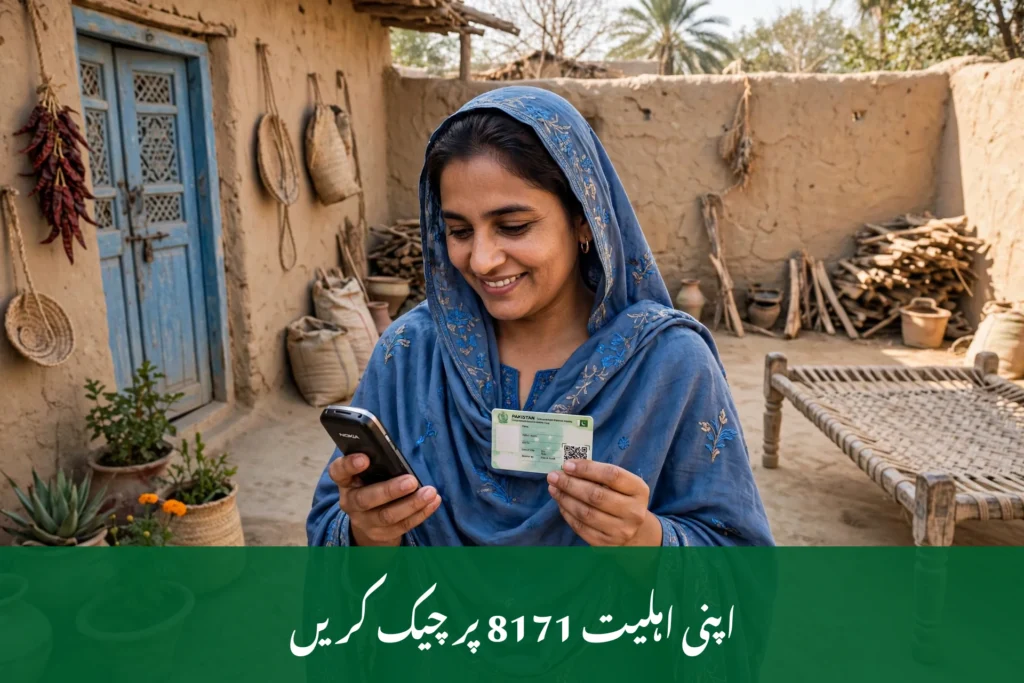
- Check your BISP status first. Send your CNIC number by SMS to 8171, or check your BISP status online on the portal at 8171.bisp.gov.pk. If you are not an active BISP beneficiary, sort your BISP registration and survey first, because this scheme selects families from BISP data.
- Confirm your poverty score band. Families scoring 0 to 20 get priority in the free track. Our PMT score check guide explains how to check it.
- Visit your nearest SRSO office. Go to your local SRSO Community Organisation or Local Support Organisation office and ask for the verification form. Field teams also visit homes in many districts.
- Fill the form with correct details. Give your CNIC number, home address, mobile number and electricity details, with your latest bill ready.
- Get the form verified and wait. The form must be verified by your Union Council Chairman or a gazetted officer. The team then checks your home, income record and electricity access. If approved, SRSO installs the Sindh free solar home system 2026 kit at your home. Do not pay anyone for installation, and keep your receipt and warranty paper safe.
If field teams have not reached your village yet, it does not mean you were rejected. Distribution moves district by district, and rural and off-grid areas are covered first. Ask your local SRSO office which phase your district is in for the Sindh free solar home system 2026.
Documents You Will Need
- Valid CNIC of the woman head of the household, plus a photocopy.
- B-Forms of children, if asked.
- Latest electricity bill, if your home has a connection, to prove your monthly units are 0–100.
- Proof of residence, such as a domicile or a utility bill, if available.
- Your own mobile number, registered in your name where possible.
- The filled verification form for the Sindh free solar home system 2026, signed and verified by the Union Council Chairman or a gazetted officer.
Take originals and photocopies together. Never hand your original CNIC to an agent or a stranger.
From Survey to Light: The Full Process
- Selection from BISP data. The Energy Department and SRSO prepare district lists from BISP records for the Sindh free solar home system 2026, starting with the poorest.
- Field survey. SRSO teams visit homes, confirm the family lives there, check electricity access, and fill the form. Duplicates are removed, since only one system is allowed per household.
- Approval and kit supply. Approved forms join the district distribution list. NETC supplies the kits, and SRSO collects them for delivery.
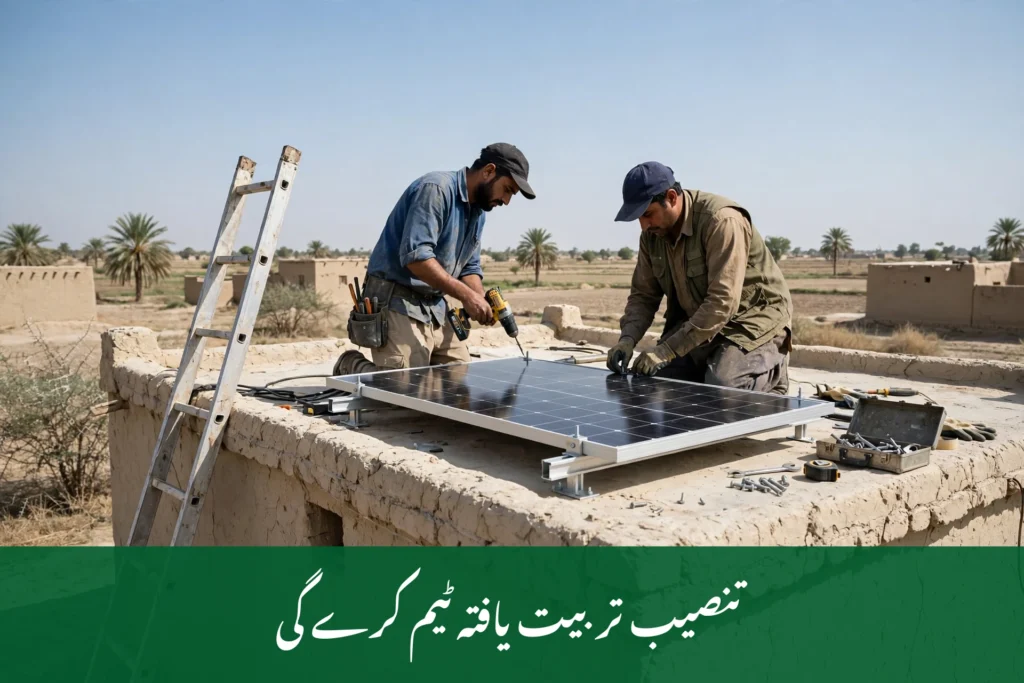
- Installation. Trained SRSO technicians install the panel, battery unit, fan, lights and wiring, and show you how to use them.
This is slow, district-by-district work, so an approved family may wait weeks.
District Rollout
The Sindh free solar home system 2026 programme covers all 30 districts of Sindh, but it did not start everywhere on the same day. The launch on 15 April 2026 began in Khairpur, Shikarpur, Larkana and Kamber-Shahdadkot, with around 100 families in each district receiving kits. Other districts follow in phases.
| Rollout point | Detail |
|---|---|
| Total districts | 30 districts of Sindh |
| Launch districts | Khairpur, Shikarpur, Larkana, Kamber-Shahdadkot |
| Priority districts reported | Shikarpur, Khairpur, Jacobabad, Larkana, Kamber-Shahdadkot, Kashmore |
| Off-grid share | 132,000 kits for areas without grid electricity |
| On-grid share | 143,000 kits for protected consumers using 0–100 units a month |
| Full district-wise list | Not officially announced |
Do not trust viral lists about your village’s turn. Check with your local SRSO office instead.

Sindh Scheme vs Punjab Solar Scheme — Do Not Mix Them
Sindh and Punjab run separate solar schemes, and applying to the wrong province wastes your time. Punjab’s programme is called Roshan Gharana, and its ballot process differs from Sindh’s BISP-based selection. If you live in Punjab, read our guide on the Punjab free solar panel scheme ballot result instead. If you live in Sindh, this Sindh free solar home system 2026 guide is the one for you. Your CNIC address decides which province’s scheme you can join.
Common Problems and Fixes
These are the most common problems families face with the Sindh free solar home system 2026, and the exact fix for each one.
| Problem | Real cause | Exact fix |
|---|---|---|
| No SMS reply from 8171 | Weak signal, wrong CNIC digits, or SIM not in your name | Resend the CNIC carefully from a SIM registered in your name; try again later |
| “Not eligible” on BISP check | Survey not done, record inactive, or poverty score above the cut-off | Visit your nearest BISP Tehsil Office and update your NSER survey, then check again |
| Field team has not visited your village | Your district phase has not started yet | Ask your local SRSO office which phase your district is in |
| Someone asks for money for a kit | Fraud — the new project kits are free | Do not pay. Report them to your SRSO office or on 0800-26477 |
| Kit installed but fan or lights do not work | Loose wire, low battery, or a faulty part | Call the SRSO installer; do not open the control unit yourself during warranty |
Fraud Warning
Free schemes attract fraudsters, and the Sindh free solar home system 2026 is no different:
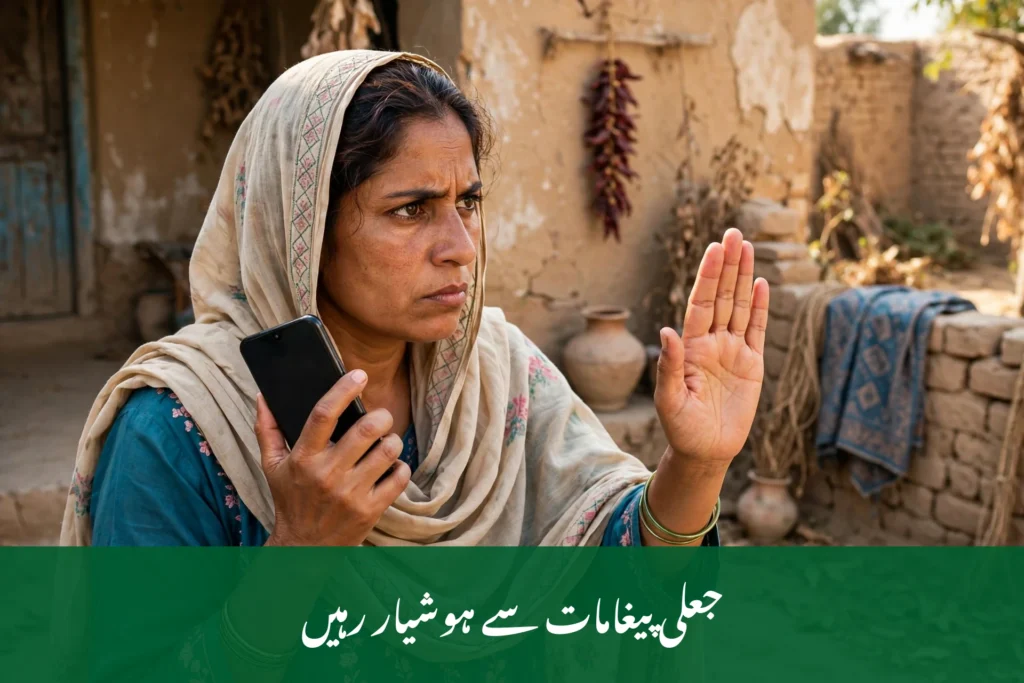
- The new project kits are free. No officer, SRSO worker or agent can ask you for cash for a kit, a form or an installation.
- No official online application portal has been announced. Any website taking your CNIC and charging a fee is fake.
- BISP messages come only from 8171. Messages from other numbers about solar kits or payments are scams.
- Never share your CNIC photo, OTP, bank PIN or wallet password with anyone.
- The older SSEP track’s reported share of around Rs. 6,000 is paid only through a Sindh Bank challan, never in cash to a person. If someone demands cash, stop and report them.
- If you get a suspicious message, read our guide on fake BISP SMS scam messages and report the number on the BISP helpline 0800-26477.
Tips for Families
- Check your BISP status on 8171 before visiting any office.
- Learn how the kit works on installation day. Ask the technician to show you the lights, the fan and the mobile charging point.
- Save power at night. The battery in the Sindh free solar home system 2026 kit is sized for lights, a fan and phone charging, not for heavy appliances.
- Keep the panel clean and clear of shade. Dust and shadows cut the power it makes.
FAQs
Is the Sindh free solar home system 2026 really free?
Yes, under the new Solar Home Systems Project the kits are free for eligible families. The government approved Rs. 18.206 billion for 275,000 free systems. The older SSEP track is subsidised by about 80 per cent, with a reported share of around Rs. 6,000.
How many households will get a solar system in Sindh?
The new Sindh free solar home system 2026 project covers 275,000 households in Sindh: 132,000 in off-grid areas and 143,000 protected on-grid consumers. The earlier World Bank-backed SSEP track targets 200,000 households. Together they form the largest household solar effort in the province’s history.
Who is eligible for the Sindh free solar home system 2026?
Low-income Sindh residents who are active BISP beneficiaries get priority, especially families with a poverty score from 0 to 20. On-grid homes must use 0–100 units of electricity a month. You need a valid CNIC, and your household must not already have a government solar system.
How can I apply for the Sindh solar home system?
There is no official online application portal announced for the Sindh free solar home system 2026. First check your BISP status by sending your CNIC to 8171. Then visit your nearest SRSO office, fill the verification form, get it verified, and wait for the survey and approval.
What is inside the solar home system kit?
The new Sindh free solar home system 2026 kit has a 180-watt solar panel, a 30Ah lithium battery, a charge controller, a mobile charging point, a 25-watt DC pedestal fan and three 5-watt LED lights. It covers basic lighting, fan use and phone charging for one household.
Which districts are covered first?
All 30 districts of Sindh are covered. The launch began on 15 April 2026 in Khairpur, Shikarpur, Larkana and Kamber-Shahdadkot. Priority is reported for high-poverty and flood-affected districts such as Jacobabad and Kashmore. A full district-wise schedule is not officially announced.
When will the solar system reach my home?
That depends on your district’s phase in the Sindh free solar home system 2026 rollout. The project started in April 2025 and is scheduled for completion by June 2027. Senate committee documents reported 170,383 systems already installed. Ask your local SRSO office which phase your district is in.

Do I need an electricity connection to get the kit?
No. The Sindh free solar home system 2026 has two parts: 132,000 kits for off-grid homes with no connection, and 143,000 kits for on-grid homes with a connection. If your village has no grid electricity, you fall in the off-grid group.
Can I get a second solar system if my first one breaks?
No, the Sindh free solar home system 2026 allows one solar home system per household. If your kit stops working inside the two-year warranty, SRSO repairs or replaces the faulty part free of charge. If it is out of warranty, repair costs are not officially announced yet.
Conclusion
The Sindh free solar home system 2026 programme is real, funded and already installing kits, with 275,000 free systems under the new project and 200,000 more under the earlier SSEP track. If you are a low-income Sindh family and an active BISP beneficiary, check your status on 8171 and visit your SRSO office. Do not pay any agent, and follow only Energy Department and SRSO announcements.

