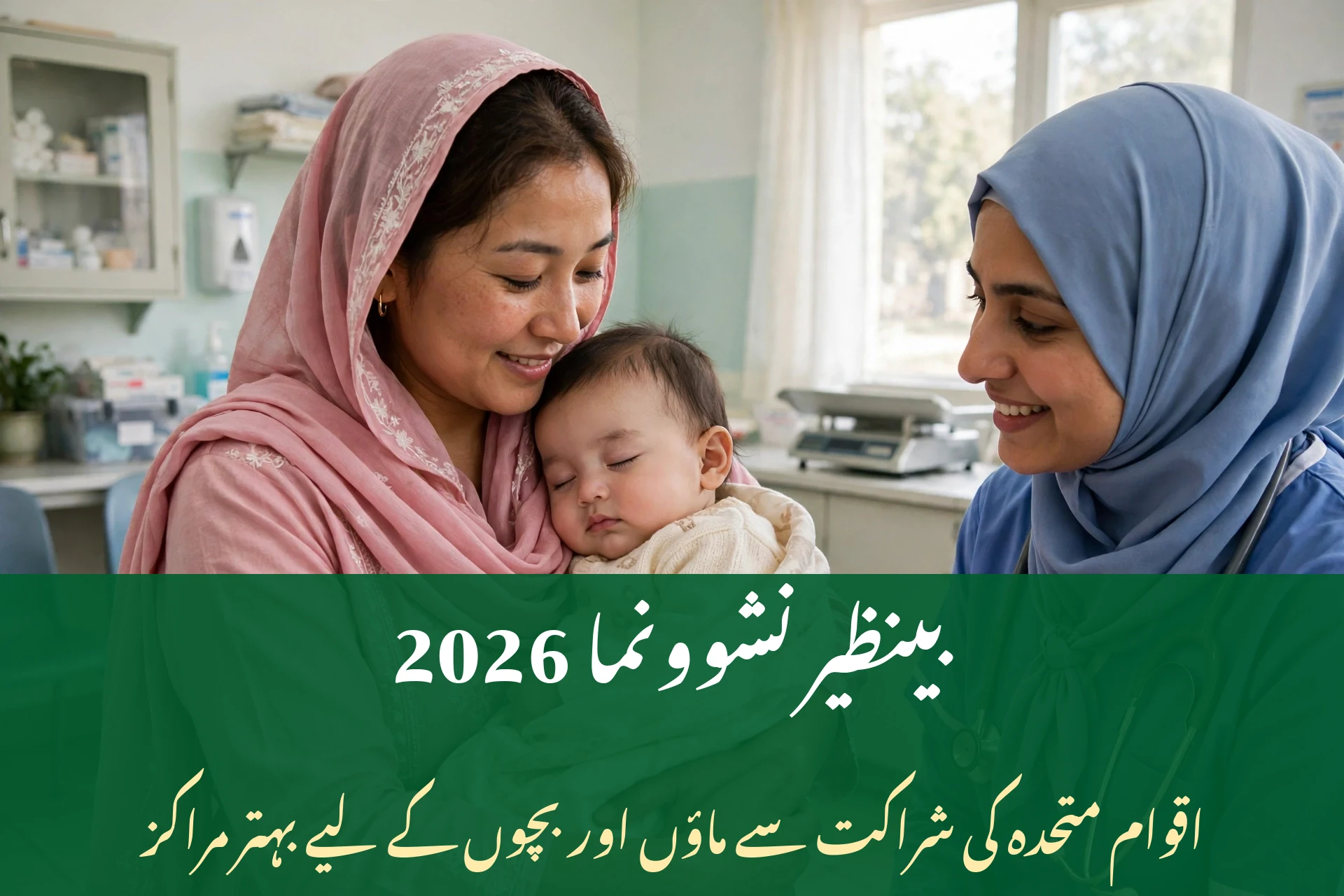
BISP Nashonuma UN Women WFP partnership 2026 is good news for mothers and young children, but it is not a new payment and it is not a new registration. On 19 October 2026, the Benazir Income Support Programme (BISP), UN Women and the World Food Programme (WFP) signed a Joint Statement of Collaboration in Islamabad. The aim is simple: make Nashonuma centres safer, more respectful and more useful for women, and help women move from support towards skills and income.
If you are already a Nashonuma mother, you do not need to apply again. Your centre visits, health checkups and payments continue as before. What changes over time is the quality of the centre you visit, the support given to the women who work there, and the links to training and digital services.
For full registration detail, read our existing guide: Benazir Nashonuma Programme 2026. That guide covers who can join and how enrolment works. This article is only about the October 2026 partnership update.
Quick Overview
| Update | BISP, UN Women and WFP Joint Statement of Collaboration |
| Signed on | 19 October 2026, Islamabad |
| Programme | Benazir Nashonuma Programme (BNP) |
| Who it helps | Pregnant women, breastfeeding mothers and children under 2 in BISP families |
| New payment announced? | No – no new payment through this partnership |
| New registration opened? | No – use the existing Nashonuma enrolment route |
| Key work | Gender assessments of up to 12 facilitation centres, staff safety review, skills and financial inclusion pathways |
| Check method | SMS CNIC to 8171 or visit 8171.bisp.gov.pk |
| Helpline | 0800-26477 (toll-free) |
| Cost | Free – never pay anyone for BISP help |
Latest Update: What Was Signed on 19 October 2026
BISP, UN Women and WFP signed a Joint Statement of Collaboration to bring gender equality and women’s empowerment into Pakistan’s largest social protection system. BISP Chairperson Senator Rubina Khalid said the partnership will help ensure that social protection services are safe, accessible and responsive to the needs of women and vulnerable communities.
This matters because BISP reaches more than 10 million women through Kafaalat. The partners want that reach to mean more than a payment: women who know their rights, centres built around their dignity and safety, and clear paths from assistance towards skills, livelihoods and financial independence.
The statement is a collaboration agreement, not a new benefit scheme. It opens no new form, helpline number or payment window.
What Nashonuma Already Is
Benazir Nashonuma is BISP’s nutrition programme for the first 1,000 days of a child’s life, from pregnancy until the child’s second birthday. Launched in August 2020 as a pilot in nine districts, it now runs in 158 districts through more than 550 facilitation centres, and has reached more than 4.6 million pregnant and breastfeeding women and children under two.

At a facilitation centre, mothers receive health checkups, nutrition counselling, child growth monitoring, specialized nutritious food, and support for routine immunization. Children with severe malnutrition are referred to nutrition stabilization centres for medical care.
An Aga Khan University evaluation shared by BISP in May 2026 found stunting risk 18 percent lower among beneficiary children at 12 months, with higher immunization coverage.
What the Partnership Will Actually Do
1. A joint working group
The three institutions will set up a Gender-Responsive Social Protection Working Group for joint planning, coordination and accountability. In practice, BISP, UN Women and WFP will plan together and track whether the work actually helps women.
2. Better centres, checked properly
Gender assessments will be carried out at up to 12 Benazir Nashonuma facilitation centres across all four provinces. The assessments will look at dignity, privacy, safety, accessibility and service quality. A Gender-Responsive Centre Framework and Checklist will be piloted and then scaled up.
For a mother, this could mean proper privacy during checkups, safe waiting space and clear information about her entitlements. Which 12 centres go first is Not officially announced; no closure or relocation has been announced.
3. Safer workplaces for women staff
The partnership will assess the needs of female Nashonuma frontline staff. The review covers workplace safety, protection from harassment, mobility, workload and career progression.
When the women who run a centre feel safe and supported, the centre runs better.
4. Rights awareness and family support
The partners will strengthen awareness among BISP and Nashonuma beneficiaries about their rights, entitlements and available public services. They will also engage men and families to promote shared care responsibilities, maternal nutrition and women’s participation in household decision-making.
In short: mothers should know their entitlements, and families should share care work.
5. Pathways to skills and income
The partnership will link women to skills, livelihoods, entrepreneurship and financial and digital inclusion, and support finalizing BISP’s Gender Strategy.
This is the long-term part. It does not mean a job or a loan tomorrow. Start dates for any specific training or loan link under this partnership are Not officially announced.

Eligibility: Who Nashonuma Already Covers
Full registration detail is in our Nashonuma guide, linked above. Do not let anyone sell you a second registration.
- You must already be enrolled under the BISP Kafaalat programme.
- You must be a pregnant woman (any stage) or a breastfeeding mother, aged 18 to 59, in a Kafaalat household.
- Your child must be under 2 years of age and the child of a Kafaalat beneficiary.
- You must live in an area where the programme has been rolled out.
- You must attend the required health checkups and follow the programme’s compliance steps, including immunization and growth monitoring visits for the child.
If you are not yet a Kafaalat beneficiary, this partnership does not make you eligible.
Payment and Benefit Table
Here is an important honesty note. The October 2026 partnership announcement did not change any payment amount. The figures below are those currently listed on BISP’s official Nashonuma programme page, not figures announced in the 19 October statement. Older figures of Rs. 2,500 and Rs. 3,000 still appear on many blogs and in a 2024 press release. If the amount you receive differs, trust your centre and the helpline, not a blog.
| Benefit | Amount per quarter (BISP programme page) |
| Pregnant woman | Rs. 3,500 |
| Boy child under 2 | Rs. 3,500 |
| Girl child under 2 | Rs. 4,000 |
| Maximum total per beneficiary over the programme | Up to Rs. 42,500 |
| BISP Kafaalat (separate, Oct-Dec 2026) | Rs. 14,500 per quarter |
| BISP Kafaalat from January 2027 | Rs. 18,000 per quarter |
Nashonuma is paid in addition to Kafaalat. Payments are quarterly and tied to health compliance: visits, awareness sessions, nutritious food use, immunization and growth monitoring. A child graduates at 2.
The higher girl-child amount is deliberate: BISP calls it gender-responsive design, encouraging equal attention to girls’ nutrition.
Important Dates
| Event | Date / Status |
| Nashonuma programme launched (pilot) | August 2020 |
| BISP-WFP Nashonuma extension (BNP 3.0) | July 2026 |
| UN Women-WFP Joint Statement signed | 19 October 2026 |
| Gender assessments of up to 12 centres | Start date Not officially announced |
| Gender-Responsive Centre Framework pilot | Date Not officially announced |
| BISP Gender Strategy finalization | Date Not officially announced |
| Skills and financial inclusion pathways launch | Dates Not officially announced |
| Kafaalat increase to Rs. 18,000 | January 2027 |
| Nashonuma child graduation age | At 2 years of age |
Trust no date for this partnership work unless it comes from bisp.gov.pk, UN Women or WFP. There is no last date, because there is no new application.
What a Mother Already in Nashonuma Should Do
These are practical steps for mothers already enrolled. They are not a new official procedure announced under the partnership.

- Keep attending your scheduled centre visits. Missed checkups can delay your quarterly support.
- Carry your original CNIC to every visit, and keep your child’s B-Form or Family Registration Certificate and immunization card safe.
- Ask centre staff, politely, whether your centre is among those being assessed, and what improvements are planned.
- If you face rude treatment, lack of privacy, or an unsafe situation, report it to the centre in-charge first, then to the helpline 0800-26477.
- Keep every SMS from 8171 until your payment is received.
- If anyone offers you a partnership registration for a fee, refuse and report the number on the helpline.
- Ask at your centre or Tehsil Office about skills training links for women in your district.

Required Documents (Brief)
- Mother’s original valid CNIC
- Child’s B-Form or Family Registration Certificate (FRC) from NADRA
- Child’s immunization card from EPI
- Pregnancy screening record from a registered health facility, for pregnant women
Full detail is in our Nashonuma guide. Show originals only at the centre or BISP office.
Process Stages: How Nashonuma Support Works
- Kafaalat enrolment comes first. Only Kafaalat families can join Nashonuma.
- Pregnancy screening or child registration takes place at a facilitation centre in a government health facility.
- Documents are checked: CNIC, FRC or B-Form, and immunization record.
- The mother attends antenatal or postnatal visits and awareness sessions as scheduled.
- Specialized nutritious food is provided as advised by health workers.
- The child’s growth is monitored and immunization kept up to date.
- Quarterly stipend is released on compliance with the visit and health conditions.
- The child graduates after turning 2.
Common Problems and Fixes
| Problem | Likely cause | What to do |
| Someone asks for a fee for partnership registration | Fraud – no such registration exists | Refuse, do not pay, report to 0800-26477 |
| You hear a new Nashonuma payment amount on social media | Old or wrong figures circulating | Check with your centre or helpline; trust bisp.gov.pk |
| Centre feels unsafe or lacks privacy | Facility problem the new assessments aim to fix | Raise it with the centre in-charge, then the helpline |
| You missed a centre visit | Illness, travel, or family problem | Visit the centre as soon as possible and explain; ask about rescheduling |
| Payment delayed after a visit | Compliance record or payment cycle timing | Check SMS from 8171, confirm your visit was recorded, call the helpline |

Fraud Warning
BISP never charges for registration, a centre visit, or this partnership. Real BISP messages come only from 8171. Never share your CNIC copy, PIN, OTP or wallet password with anyone who calls or messages you. Never pay an agent who promises faster payment, a bigger stipend, or a place in a new UN list. There is no such list. Report suspicious numbers on 0800-26477 or at your nearest BISP Tehsil Office.
Tips for Beneficiaries
- Attend every scheduled visit, even when you feel well.
- Take the specialized nutritious food exactly as health workers advise. It supplements, not replaces, normal food.
- Keep your child’s immunization card updated.
- Involve your family. Shared care at home helps mothers rest and children thrive.
- Save the helpline number 0800-26477 in your phone today, before you need it.

Frequently Asked Questions
1. What is the BISP Nashonuma UN Women WFP partnership 2026?
It is a Joint Statement of Collaboration signed on 19 October 2026 by BISP, UN Women and WFP. It aims to make social protection gender-responsive, improve Nashonuma centres and staff support, and link women to skills and financial inclusion. It is not a new payment scheme.
2. Do I need to register for this partnership?
No. There is no separate registration for this partnership and nothing new is open to apply for. If you are already enrolled in Nashonuma, you continue as before. New mothers should follow the normal Nashonuma enrolment route through a facilitation centre.
3. Will my Nashonuma payment increase because of this partnership?
No increase was announced in the 19 October 2026 statement. BISP’s programme page currently lists Rs. 3,500 per quarter for a pregnant woman or boy child and Rs. 4,000 for a girl child. Confirm your own amount at your centre.
4. Which 12 Nashonuma centres will be assessed first?
That list is Not officially announced. The assessments will cover up to 12 facilitation centres across all four provinces, checking dignity, privacy, safety, accessibility and service quality. No centre closure or relocation has been announced, so keep using your usual centre.
5. What is the Gender-Responsive Centre Framework?
It is a framework and checklist the partners will pilot and then scale up to improve how Nashonuma centres serve women. It covers privacy, safety, accessibility and service quality. Its pilot date is Not officially announced, so centres will change gradually, not overnight.
6. How does the partnership help women frontline staff?
It will assess female Nashonuma frontline staff needs, including workplace safety, protection from harassment, mobility, workload and career progression. Better supported staff means better-run centres and better care for mothers and children visiting them every day, so mothers can trust the care they receive.
7. Can this partnership help me learn a skill or start a small business?
In time, yes, that is the intention. The partnership aims to link women to skills, livelihoods, entrepreneurship and financial and digital inclusion. Specific training or loan start dates are Not officially announced, so ask at your centre and Tehsil Office.
8. Is Nashonuma only for pregnant women?
No. Nashonuma covers pregnant women, breastfeeding mothers and children under 2 years of age in BISP Kafaalat families. Support runs from pregnancy until the child turns 2, provided health visits, immunization and growth monitoring conditions are met on schedule at each visit.

9. Where can I check my Nashonuma status or complain?
Send your CNIC by SMS to 8171, visit 8171.bisp.gov.pk, or call the toll-free helpline 0800-26477. You can also visit your facilitation centre or nearest BISP Tehsil Office. Never pay anyone for this help, and never share your PIN or OTP.
Conclusion
The BISP Nashonuma UN Women WFP partnership 2026 is a welcome step for mothers and children. Safer centres, respected staff, informed mothers and real links to skills and income would make a good programme better. But keep expectations honest: no new payment and no new registration came with the 19 October signing. Keep attending your centre, keep your documents ready, and verify every claim on bisp.gov.pk or the helpline 0800-26477. Share this update with a Nashonuma mother in your family so rumours do not reach her first.
Related guides
- Benazir Nashonuma Programme 2026
- BISP Kafaalat December 2026 Payment
- BISP 8171 Under Verification Status 2026
- BISP Complaint Registration 2026
- Benazir Hunarmand Program 2026
Sources
- BISP, UN Women and WFP partnership report, Islamabad Post (19 Oct 2026): https://islamabadpost.com.pk/bisp-partners-un-women-and-wfp-to-strengthen-gender-equality/
- BISP, UN Women and WFP joint commitment report, Sabah News (19 Oct 2026): https://sabahnews.net/english/news/bisp-un-women-and-wfp-reaffirm-joint-commitment-to-gender-responsive-social-protection-and-womens-economic-empowerment-in-pakistan/
- Benazir Nashonuma Programme, official BISP programme page: https://bisp.gov.pk/Detail/YjAyMjI5ZDQtMTVkOC00YTNlLWE5NjctMjA1NTYwN2JhOTE3
- BISP-WFP-UNICEF-WHO Nashonuma extension press release, BISP (9 July 2026): https://www.bisp.gov.pk/SiteImage/Misc/files/53(1).pdf
- Aga Khan University Nashonuma endline evaluation report, BISP (7 May 2026): https://www.bisp.gov.pk/SiteImage/Misc/files/37.pdf
- Official portal: https://8171.bisp.gov.pk – Official BISP site: https://bisp.gov.pk
Disclaimer
This information is based on official announcements and may change. Verify at bisp.gov.pk or by calling the BISP helpline 0800-26477 before acting on it.

