
BISP Kafaalat elderly women can still receive the full quarterly payment, even if age, weak eyesight, or faded fingerprints make the process harder. This guide explains who qualifies, how the household survey score works, what to do when a thumbprint does not match, and how family members can help without breaking the rules. Confirm your status on the official portal before travelling.
Quick Overview
| Detail | Information |
| Program | Benazir Kafaalat (BISP) |
| Who it is for | Ever-married women in eligible low-income households, including elderly women |
| Current payment | Rs. 14,500 per quarter (October–December 2026) |
| Next payment | Rs. 18,000 per quarter from January 2027 |
| Payment cycle | Once every three months |
| Check method | Send 13-digit CNIC by SMS to 8171, or visit 8171.bisp.gov.pk |
| Helpline | 0800-26477 (free) |
| Registration and survey | Free at the nearest BISP Tehsil Office |
| Wallet deadline | December 31, 2026 |
| Cash withdrawal charge | Rs. 280 per wallet cash withdrawal; RAAST transfer is free |
Latest Update for Elderly Women
The current Kafaalat payment is Rs. 14,500 per quarter for October to December 2026. From January 2027, the quarterly payment rises to Rs. 18,000.
One point families often get wrong: BISP has not announced a separate, higher payment only for elderly women, nor a separate minimum age for Kafaalat. An elderly woman qualifies through the same household route: a completed NSER survey, a PMT score within the cut-off, and a valid CNIC in her own name.
Age alone does not disqualify her; if her household is eligible, she is treated like any other beneficiary. The extra help she needs is practical — travel, reading messages, biometric checks — not a different form.
Eligibility Criteria for Elderly Women
Eligibility is decided at household level, not by age alone:
- The beneficiary must be an ever-married woman with a valid, unexpired CNIC.
- The household must have completed the NSER (dynamic) survey.
- The PMT score must be within the cut-off: 32 or below generally, 37 or below for a household with a disabled member.
- No disqualifying filter should apply, such as a government job, a registered vehicle, or frequent travel.
- Her CNIC, mobile number, and household record must match NADRA and BISP records.
Old age, widowhood, and disability all point the same way, but none replaces the survey score. If she lives with her son or daughter, the whole household is surveyed together, and their income and assets count. Widows and disability households have separate guides, mentioned here only where rules overlap; an elderly widow needs no second registration.
Payment Amount and Benefits
| Quarter | Amount | Status |
| October–December 2026 | Rs. 14,500 | Current quarter |
| January–March 2027 | Rs. 18,000 | Announced increase |
The payment is quarterly, not monthly. A missed payment is not automatically lost, but it is not released until the record is fixed — check the status, fix the record, then collect.
Important Dates
| Event | Date |
| Current quarter | October–December 2026 |
| Current payment | Rs. 14,500 per quarter |
| Digital wallet / SIM deadline | December 31, 2026 |
| Increased payment starts | January 2027 (Rs. 18,000 per quarter) |
| Exact district release date for this quarter | Not officially announced — payments are released in phases, so check by SMS or portal |
Do not trust a forwarded message giving an exact payment date for your district. Payments are released in phases; your own SMS reply or portal result is the only reliable date.
How to Check Eligibility: Step by Step
A family member can do these steps with her, using her CNIC and her own mobile number.
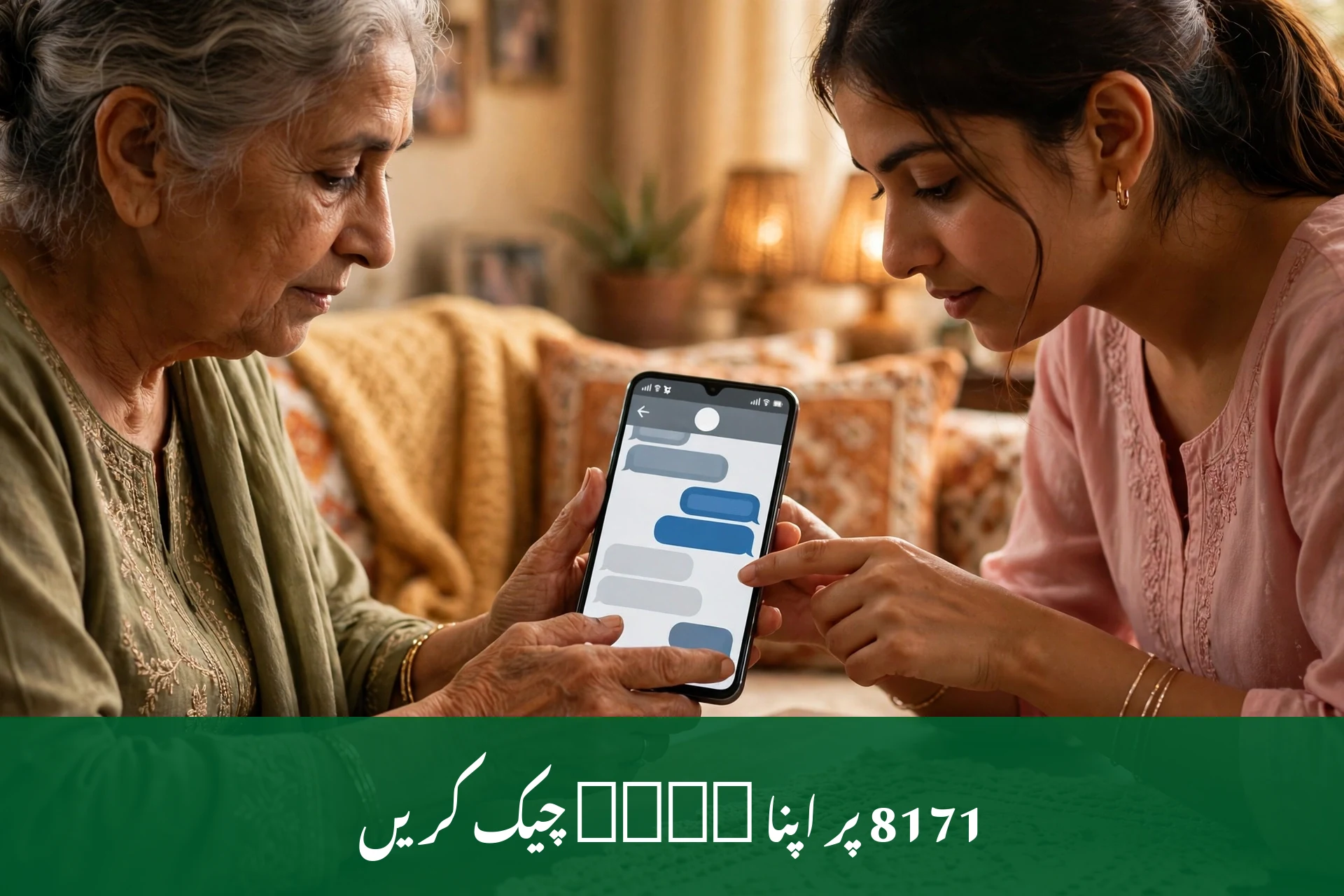
- Type her 13-digit CNIC number without dashes.
- Send it by SMS to 8171.
- Read the reply, or ask a trusted family member to read it aloud.
- With internet, you can also check on 8171.bisp.gov.pk with the CNIC number and picture code.
- If it says “eligible” and payment is released, plan the collection visit.
- If it says “under verification,” wait and check again — BISP is still checking the record with NADRA.
- If it says “not eligible,” visit the Tehsil Office and ask whether a new dynamic survey is needed.
Keep the reply message; Tehsil Office staff may ask what it said.
Required Documents
Take originals, not photocopies alone:
- Original CNIC of the elderly woman beneficiary
- CNICs of adult family members, if asked for during a survey
- Children’s B-Forms, if asked for during a survey
- Her own mobile phone and SIM, in her name where possible
- Her husband’s death certificate, if she is a widow and the office asks for it
- Disability certificate, if the household claims the higher PMT cut-off
Never hand originals to an agent. Show them to BISP or NADRA staff, and take them back before leaving.
Verification Process: From Survey to Money in Hand
- Household survey: The NSER dynamic survey is completed at the Tehsil Office.
- PMT scoring: BISP calculates the household poverty score.
- NADRA check: Her CNIC and biometrics are matched with NADRA records.
- 8171 result: The family checks eligibility by SMS or portal.
- Payment release: The payment goes to the payment point or wallet.
- Biometric collection: She verifies with her own fingerprint at the payment point, ATM, or agent.
- Receipt: She receives the full amount and a printed receipt.
If any stage fails, later stages stop. Fix the exact stage that failed instead of starting over.
CNIC and Biometric Problems for Elderly Women
This is the most common problem for older beneficiaries, and it has a clear order of fixes.
Faded fingerprints come with age and years of housework or manual work; dry skin, dust, cuts, and old scanners make it worse. First, wash and dry the hands, remove oil, and ask the operator to try a different finger, including the other hand. If it still fails, try another payment point or machine. If it keeps failing, visit a NADRA centre for a biometric update, wait a few days, then retry. If it still fails, ask the Tehsil Office about non-biometric verification; a separate guide covers the full fingerprint fix.
Note honestly: the current non-biometric verification procedure in the digital wallet period is Not officially announced in a current BISP notice this guide could verify. Do not pay anyone who promises to “activate” it; ask the Tehsil Office in person, with the original CNIC.

Family Help Rules: Who May Help, and What Helpers Cannot Do
An elderly woman does not have to manage this alone, but the rules draw a firm line between helping and taking over. A family member may:
- Travel with her to the Tehsil Office, NADRA centre, or payment point
- Read her 8171 SMS reply aloud and explain it
- Dial helpline 0800-26477 with her, or for her with her knowledge
- Carry her documents, help her use her own phone and SIM, and count the money with her at the counter before leaving
A family member may not:
- Collect the payment by showing only their own CNIC
- Use their own thumbprint to take her payment
- Keep her CNIC, phone, SIM, or card, or take her PIN or OTP, without her permission
- Deduct a “fee” or “help charge” from her payment
- Register a wallet or SIM in their own name and call it hers
The payment belongs to the woman named in the BISP record; her own CNIC and biometric check release it. A helper who insists on handling the phone, PIN, or cash alone is a warning sign — report pressure to the Tehsil Office or helpline. If she cannot travel at all, explain in person at the Tehsil Office. Whether a home visit or nominee route exists in her district is Not officially announced as a nationwide rule, so do not accept an agent’s promise of one.

Common Problems and Fixes
| Problem | Real cause | Exact fix |
| SMS says “not eligible” | No survey, or PMT above cut-off | Ask the Tehsil Office for a dynamic survey |
| “Under verification” | NADRA and BISP checks running | Wait, then check again; pay no one to speed it up |
| Fingerprint does not match | Faded prints, dry skin, old scanner | Clean dry hands, try another finger and machine, then update at NADRA |
| Still fails after NADRA update | Record not synced, or prints unreadable | Wait a few days, retry, then ask the Tehsil Office about non-biometric verification |
| CNIC expired | NADRA record out of date | Renew the CNIC at NADRA, then check 8171 again |
| SIM not in her name | Wallet and SMS checks do not match | Get a SIM in her own name, where the free SIM route is available |
| Payment released but not received | Wrong point, deduction, or record issue | Ask for a receipt, then complain at the Tehsil Office or helpline |
| Less than Rs. 14,500 received | Deduction or wallet cash fee | Count at the counter, report any deduction at once |
For deductions, see the complaint registration guide. Never accept “the system cut it” without a receipt.
Fraud Warning
BISP messages come only from 8171; a message from a personal number claiming to be BISP is fake. Everything here is free: the survey, the eligibility check, and registration. Never pay an agent to register you, release a payment, fix a fingerprint, or raise a PMT score — no agent can change one. Never share your PIN or OTP, hand your phone to a retailer, or share a photo of your CNIC on WhatsApp. If someone demands money or a code, stop, keep the message, and call 0800-26477.

Tips for Elderly Beneficiaries and Their Families
- Check the 8171 status before travelling, to avoid a wasted trip.
- Go early, take water, and bring a trusted companion.
- Keep the CNIC, phone, and receipt in one small bag that stays with her.
- Count the full Rs. 14,500 at the counter and ask for the receipt.
- Use RAAST transfers to avoid the Rs. 280 cash fee, and withdraw larger amounts less often.
- Update the survey when the household changes, because an old record causes most “not eligible” surprises.
FAQs
1. Can an elderly woman get BISP Kafaalat?
Yes, if her household qualifies. There is no separate elderly-only payment, and age alone does not disqualify her. She must be an ever-married woman with a valid CNIC, her household must have a completed NSER survey, and the PMT score must be within the cut-off.
2. Is there a minimum age for elderly women in Kafaalat?
No separate minimum age for elderly women is officially published for Kafaalat. BISP decides eligibility from the household survey and PMT score, not from a special senior-citizen age limit. The detail is therefore Not officially announced, and families should not trust any forwarded age rule.

3. Does an elderly woman get more money than other women?
No. The payment is the same for all Kafaalat women: Rs. 14,500 per quarter in October to December 2026, rising to Rs. 18,000 from January 2027. No extra elderly amount has been officially announced, so anyone promising a higher senior payment is not telling the truth.
4. What is the PMT score needed for an elderly woman’s household?
The household needs a PMT score of 32 or below in general, or 37 or below if a household member has a disability. The score belongs to the whole household, not to the elderly woman alone, so the income and assets of family members living with her also count.
5. What should she do if her fingerprint does not match?
First, wash and dry her hands, try another finger, and try another payment machine. If it still fails, update her fingerprints at a NADRA centre, wait a few days, and retry. If it keeps failing, visit the BISP Tehsil Office and ask about non-biometric verification.
6. Can her son or daughter collect the payment for her?
No, not by showing only their own CNIC or thumbprint. The payment is released on the beneficiary’s own CNIC and biometric check. Family members may travel with her, help her read messages, and support her at the counter, but they cannot take the payment in her place.
7. What if an elderly woman cannot travel to the payment point?
The family should visit the BISP Tehsil Office in person and explain her illness or disability. Whether a home visit or nominee route is available in her district is Not officially announced as a nationwide rule, so get the answer from BISP staff rather than from an agent.
8. What documents does an elderly woman need?
She needs her original CNIC above all. For a survey, the office may also ask for adult family members’ CNICs, children’s B-Forms, her own mobile phone and SIM, and, for widows, her husband’s death certificate. Take originals and bring them home again.

9. How can the family check her payment without internet?
Send her 13-digit CNIC number, without dashes, by SMS to 8171 from any basic mobile phone. The reply shows her eligibility and payment status. A family member can read the reply aloud, but the check itself is free and needs no smartphone or app.
Conclusion
BISP Kafaalat elderly women do not need a different program — they need the same program made reachable. Complete the survey, keep the CNIC valid, check 8171 before travelling, and fix fingerprint problems through NADRA and the Tehsil Office in that order. Families can help with every step except the one that matters most: the payment belongs to the elderly woman and must reach her hands in full. If anything goes wrong, call 0800-26477 — and never pay anyone.
Related guides
- BISP fingerprint verification failed fix
- BISP Kafaalat widows eligibility 2026
- BISP complaint registration 2026
- BISP wallet transfer guide RAAST JazzCash Easypaisa
- 8171 SMS reply meanings 2026
Sources
- Benazir Income Support Programme, bisp.gov.pk — program and eligibility
- BISP 8171 Web Portal, 8171.bisp.gov.pk — official CNIC and payment check
- State Bank of Pakistan — wallet charges: Rs. 280 cash withdrawal, RAAST free; deadline December 31, 2026
- Federal budget / government announcements for the January 2027 increase to Rs. 18,000
- BISP helpline 0800-26477
Disclaimer
This information is based on official BISP announcements and may change. Verify your status at bisp.gov.pk, 8171.bisp.gov.pk, or 0800-26477 first. Details marked “Not officially announced” have not been published in a verifiable official notice; confirm them at your nearest Tehsil Office.

